


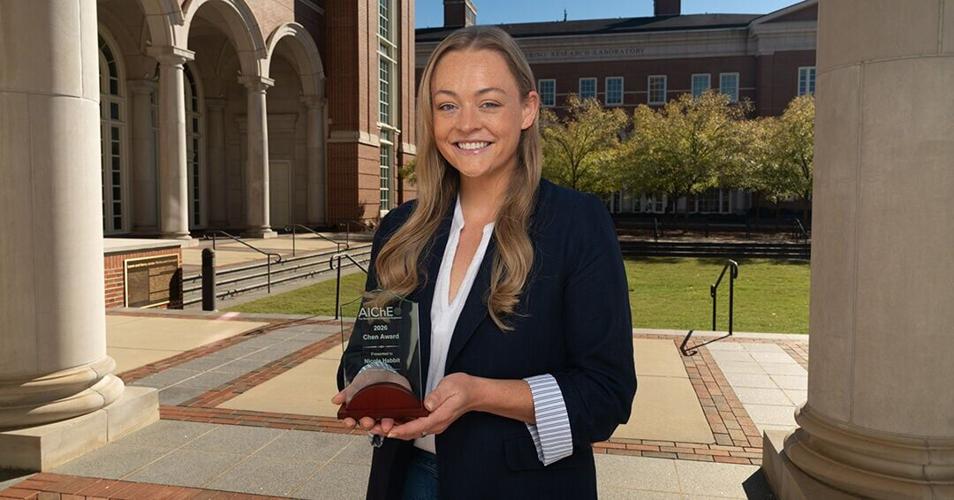
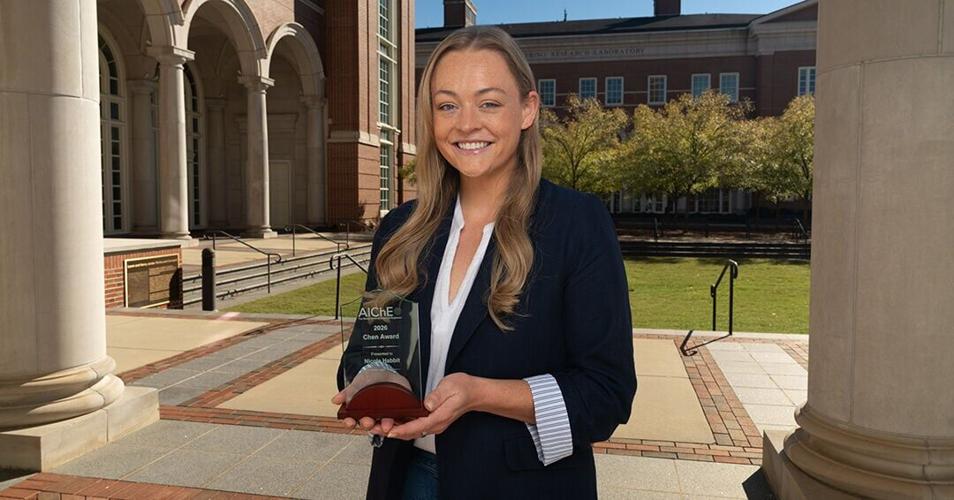
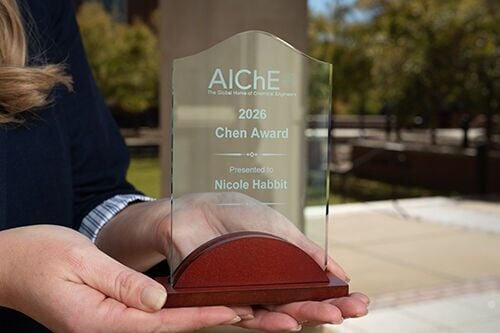
Nicole Habbit, a lecturer in the Department of Chemical Engineering, is one of three recipients nationally of the 2026 American Institute of Chemical Engineers (AIChE) John C. Chen Early Career Leadership Scholarship.
The award recognizes emerging chemical engineering professionals who have demonstrated involvement in the organization, excellence in the profession and volunteer service.
Habbit checks those boxes.
She teaches multiple chemical engineering courses, helps shape curriculum and recruit students for the university’s new biomedical engineering graduate programs and advises two service-oriented student organizations.
“AIChE provides a forum to share ideas, address emerging challenges and ensure that the work we do remains relevant, all while advancing engineering’s broader goal of solving problems and improving people’s lives,” Habbit said. “I’m incredibly honored to be recognized by this organization which brings chemical engineers together to help shape the future of the profession.”
People are also reading…
She was among those honored at the organization’s annual conference Nov. 7 in Minneapolis at the Gathering of Leadership dinner kicking off AIChE’s annual meeting.
Selen Cremaschi, Department of Chemical Engineering chair, said Habbit’s impact extends “well beyond the classroom.”
“One of Nicole’s greatest strengths is her commitment to helping others,” Cremaschi said. “She invests deeply in her students, contributes to the profession through service and leadership and continually looks for ways to create opportunities that benefit those around her. This recognition is a well-deserved reflection of those efforts.”
Habbit is launching a design team through the Biomedical Engineering Society that will pair students with community members facing health challenges, giving them hands-on experience developing practical solutions to improve quality of life.
“What I’ve envisioned is finding someone within the Auburn Family who is facing a health challenge and creating a project around that need,” said Habbit, who also serves as faculty advisor for Omega Chi Epsilon, the Chemical Engineering Honor Society. “The goal is to find someone in the community each year, listen to their needs and create something that helps. I want our students to see that their skills can improve someone’s life and to have the experience of looking that person in the eye and handing them something they created for them.”
How did Habbit, an Albuquerque, New Mexico, native, wind up in Auburn, Alabama? AIChE, actually.
After earning a bachelor’s degree in chemical engineering with a concentration in bioengineering from the University of New Mexico, she considered pursuing medical school, veterinary medicine or graduate-level research. She didn’t know for sure until a chance meeting at an AIChE-sponsored chemical engineering conference.
Guess which university had a booth…
“I was able to talk to some of the Auburn faculty and I found out that I could do my Ph.D. but still have a research focus that was very much aimed at either human health or veterinary medicine,” said Habbit, who was active in New Mexico’s AIChE student chapter as an undergraduate. “Auburn chemical engineering was the best fit for me to be able to blend my interests into one career. AIChE has provided so many leadership opportunities for me and, of course, introduced me to Auburn.”
Habbit chose Auburn, where she earned master’s and doctoral degrees in chemical engineering. Elizabeth Lipke, lead developer of the university’s biomedical engineering graduate programs and the Uthlaut Endowed Professor of Chemical Engineering, was her faculty advisor.
Auburn’s biomedical engineering graduate programs will offer master’s, doctoral and graduate certificate pathways focused on applying engineering principles to challenges in human health and medicine.
“What might be a bit unique about our programs is that because Auburn Engineering has so many phenomenal industry relationships, what we’re trying to do is extend that into the growing healthcare industry in the state, and beyond, preparing our students to meet needs that currently exist for companies in this area,” Habbit said.
“Having the opportunity to bring degree options to campus that our students want is opening a pathway for the next generation. Watching students one day make significant advances in how we diagnose, monitor and treat health conditions is incredibly meaningful to me.”
Media Contact:
Joe McAdory, jem0040@auburn.edu, 334.844.3447


