


Teaching a room full of veterinary students to intubate a goat is no easy task. The animal’s small mouth and airway can make the procedure tricky and nearly impossible for a room full of students to observe.
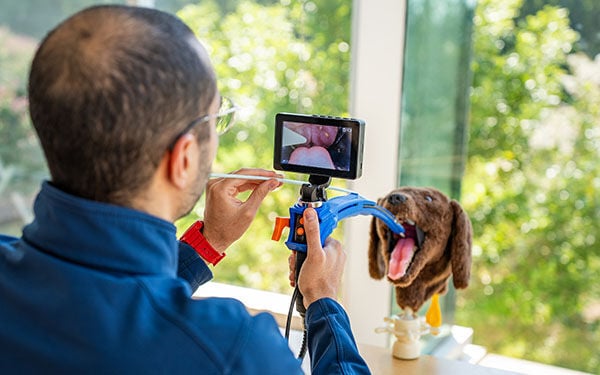
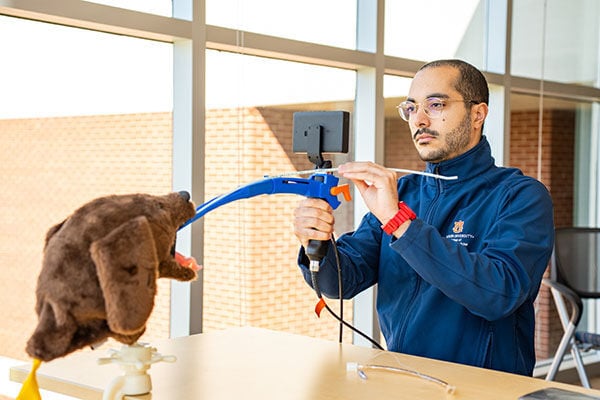
To tackle that problem, the College of Veterinary Medicine’s large-animal anesthesia team teamed up with the Samuel Ginn College of Engineering to develop a low-cost, camera-equipped, 3D-printed laryngoscope that displays the procedure in real time.
The problem
Veterinary technician Katie Ray has coached hundreds of veterinary students through their first large-animal intubations using traditional metal laryngoscopes. Having seen how video laryngoscopes improve visibility and guide tube placement in human medicine, Ray wondered if a similar tool could help veterinary students. But there wasn’t an equivalent product on the market for ruminants.
People are also reading…
Ray needed footage of an intubation to include in a continuing education presentation and decided to get creative. She bought a $30 borescope camera, connected it to her phone and used it alongside a traditional laryngoscope to film the procedure. She was impressed by the results and started using it to give students a better view during labs.
The project gained momentum when anesthesia resident Dr. Nassim Bouhabib joined the team and modified the prototype by attaching the camera directly to the laryngoscope. Recognizing the potential for a more refined solution, Ray and Bouhabib partnered with the College of Engineering to develop a device specifically catered to their needs.
The process
The Vet Med team linked up with engineering students Will Jones and Cooper Rice in the College of Engineering’s Mechanical Polymer Additive Manufacturing (ME3D) Laboratory to explore 3D-printed solutions. The project gave the mechanical engineering duo a hands-on opportunity to tackle a real-world problem alongside a real-world client.
“Getting to do that in the stage that we are in our education was very helpful because it gives us a taste of what things will be like in the future,” said Jones, a senior in his third year working in the lab.
Collaboration was central to the project’s success. Over the course of development, the team went through multiple designs, testing and refining along the way. Visits to the Auburn Vet Med campus allowed Jones and Rice to see the tool in action, gather feedback and incorporate new ideas into updated versions.
For Rice, who graduated in May 2026, the project was among the highlights of his time working in the lab. Along with gaining experience, he expanded his technical skills by exploring new modeling techniques, computer-aided design functions and 3D-printing materials.
ME3D Director Jordan Roberts said the collaboration was beneficial for both groups. The Vet Med team received a customized solution, while the engineering students gained experience applying classroom concepts to a real-world product development project.
“This is another example of an excellent experience for our students,” Roberts said. “They gained new insights into subject matter very much outside of our normal areas of practice while learning from world-class practitioners like the Auburn Vet Med team.”
The solution
After nearly a year, the team finalized a 3D-printed laryngoscope with special features tailored for large-animal intubation. A lever-controlled camera allows users to adjust the viewing angle for a clearer look at the airway, while a large display screen provides a real-time view of the intubation process. The device also includes an adjustable blade that allows it to be used on animals of different sizes, all for $150.
While the product has proven useful with patients, the biggest success in Ray’s eyes is the improved experience for students, many of whom have never worked with goats or pigs before labs.
“It’s a teaching enhancement,” Ray said. While students still learn to intubate using traditional laryngoscopes, the new device provides valuable visual support for those just learning the procedure. “If you’re a visual learner — and a lot of our students are — this tool gives them something they can see rather than us just explaining it.”
Now that the product design is complete, the next step is to get it into the hands of those who can use it. The team has submitted a paper for publication that includes the files needed to 3D print the device. Once published, practitioners will have the ability to replicate the low-cost tool for their own use.
Beyond producing a new teaching tool, the project demonstrated the value of collaboration across colleges and within the veterinary profession. For Ray, who helped shepherd the idea from concept and funding to development and publication, the experience highlighted the important role veterinary technicians can play in advancing innovation and research.
“This project was a great way to bridge the gap between veterinarians and technicians,” Ray said. “There’s definitely room for more veterinary technicians to be involved in research.”


