
One minute, Goose was in the backyard for a late-night trip to the restroom — a seemingly zero-risk activity for a competitive dock diving border collie.
The next minute, Goose could not use his hind legs.
“All I could think was, ‘This is permanent,’” said Dr. Robyn Wilborn, Goose’s owner and a professor of theriogenology in the College of Veterinary Medicine.
Wilborn loaded Goose up for a trip to the emergency room at the college’s Bailey Small Animal Teaching Hospital, where Goose was diagnosed with fibrocartilaginous embolism (FCE), or spinal stroke.
Thanks to his care team and his own personal drive, Goose went from being paralyzed to competing in his second trip to Dock Diving Nationals in just eight months.
A diagnosis without a cure
People are also reading…
Neurology specialty intern Dr. Fernanda Catacci Guimarães has seen her share of canine spinal injuries during her two years at the teaching hospital. When Goose arrived, Guimarães worked with neurologist Dr. Stacey Sullivan, her faculty mentor, to sort through the puzzle pieces and form a full picture. Sudden onset of paralysis after physical activity? Check. No lingering signs of pain? Check. All signs pointed to an FCE, and an MRI confirmed her suspicion.
Primarily seen in large-breed dogs, FCEs occur when a piece of an intervertebral disc enters the bloodstream and blocks blood vessels leading to the spinal cord. This prevents blood from getting to the spinal cord, causing a section to die.
While there is currently no surgical option to repair the damage, there is a high chance of recovery for most FCE patients through physical rehabilitation. Guimarães says the sooner patients start rehab, most often, the faster they recover.
Putting in the work
Goose immediately started working with Liz Hodson and Carrie Spivey with the hospital’s physical rehabilitation team after the injury on Feb. 4, 2025. Goose’s back legs were too weak to walk, but he showed signs of some movement. After 48 hours, he could advance his right back leg, but he still had trouble moving his left.
“In FCEs, the first two weeks are very important for physical rehabilitation,” Spivey said. “With these injuries, we don’t ever know where we can get them to. All we can do is try.”
So, Spivey, Hodson, Goose and the Wilborn family tried.
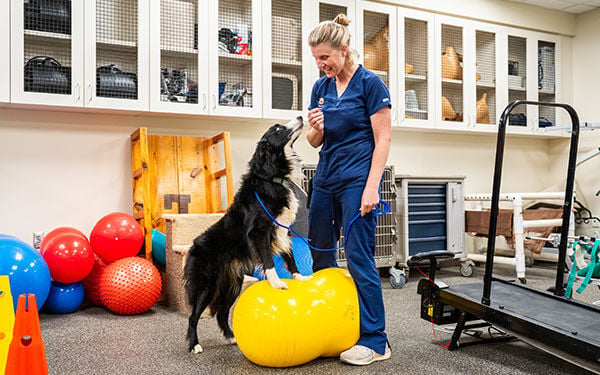
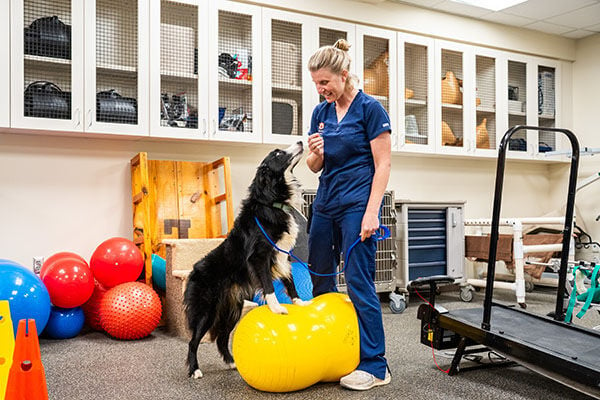
Wilborn brought Goose in for daily rehab sessions where he incrementally expanded his movements by using dry and underwater treadmills, standing on balance discs and walking on different surfaces, such as sand and gravel, to target specific muscles.
It was not a chore for Goose. He craved exercise.
“For him, it’s not doing something that he needs to do to recover,” Guimarães said. “It’s just doing something that he loves.”
Three weeks later, he was given the green light to drop down to three physical rehabilitation appointments per week. Three months later, he was cleared to get back to dock diving.
As part of her master’s degree in biological sciences, Guimarães is working on a case study about Goose’s recovery to encourage other veterinarians to start rehab with FCE patients as early as possible. She said there is no reason to wait — once the injury occurs, it either stays static or improves. Clinical physical rehabilitation and exercise will not cause further damage to the initial injury.
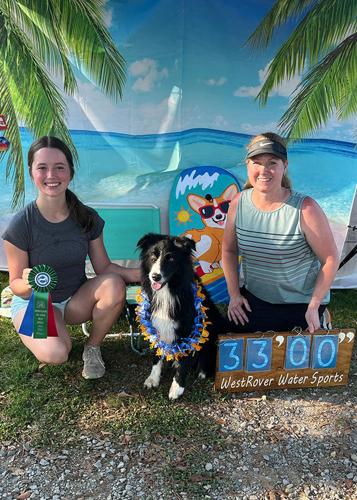
On April 22, Wilborn and her husband brought Goose to WestRover Water Sports & Agility Club where he first started competitive dock diving a year before. Goose was ecstatic to be there and dove right in, wasting no time getting back to the water and bringing tears to Wilborn’s eyes. Four days later, he was back to competing at his usual stomping grounds, including Harvard’s K9 Center in Opelika and Champion Crossroads Canine in Pine Mountain, Georgia.
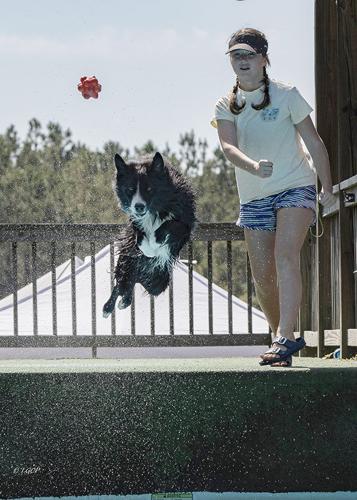
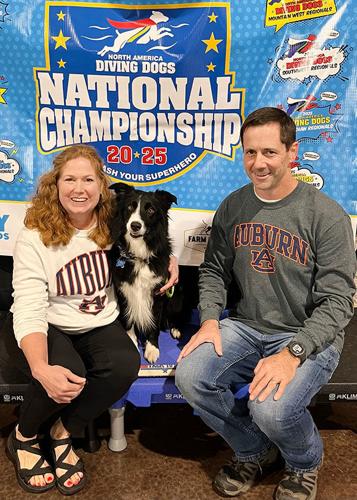
At just eight months post-injury, Goose competed for the second time in the Dock Diving Nationals held each October in Springfield, Missouri. While his gait and use of his back legs will never be fully restored, he did not let that stop him. Goose nearly tied his personal best distance from the year before in the air retrieve event, jumping 18 feet to grab a bumper suspended in air above the competition pool.
Wilborn and the rehab team have worked together to hone Goose’s training. They tailor his training by reviewing videos of his competition dives and focusing efforts on exercises that strengthen those specific movements. Hodson said that open line of communication between owners and the rehab team is critical to getting pets back to where they need to be.
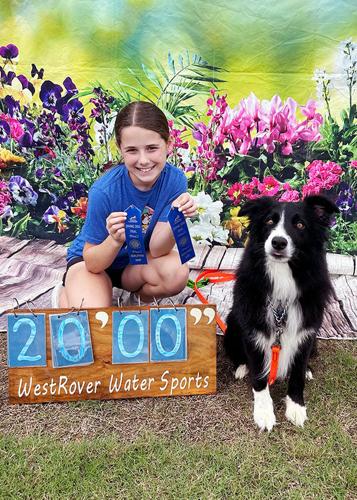
Goose first began dock diving in 2023, honing his skills with help from Wilborn’s family.
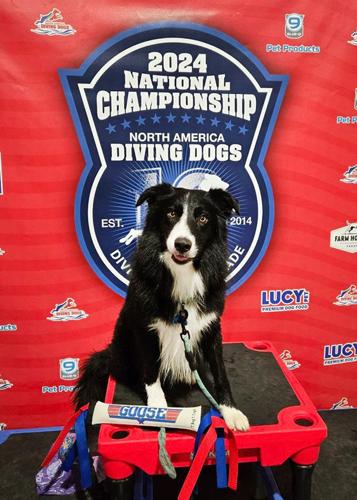
After his first competition season, Goose earned a trip to the Dock Diving Nationals in October 2024.
Three months after his injury and several physical rehabilitation appointments later, Goose was back to competing.
Goose returned to the Dock Diving Nationals in 2025, just eight months after his injury.
Results that fuel care
More than a year later, Wilborn still brings Goose to rehab once a week to stay in tip-top shape for competitions and, of course, to visit his friends Hodson and Spivey.
“He gets so excited going to rehab; it’s the highlight of his week,” Wilborn said. “A big part of weekly rehab was for the rehab team to watch for things I couldn’t see. When it’s your personal dog — even when you’re a vet — you can’t see things with the same eyes that you could if it were a client.”
For most of her rehabilitation patients, Spivey said the primary goal is to help them get back to their daily activities. Since most dogs are not award-winning athletes, Spivey said it was a welcomed challenge to help get Goose competition ready.
“Being able to work with a dog that is competing and to have bigger goals, for me, was very fun,” Spivey said. “Cases like this is why I do what I do.”
Guimarães said that same sense of satisfaction in restoring patients’ abilities sparked her love for neurology.
“It’s so gratifying to see a patient that is not walking gain their quality of life again because both you and the patient are making some effort,” Guimarães said.
Thanks to hard work across the board, from the neurology and rehab teams to his coaches at home, Goose’s dock diving career will not be coming to an end any time soon.