


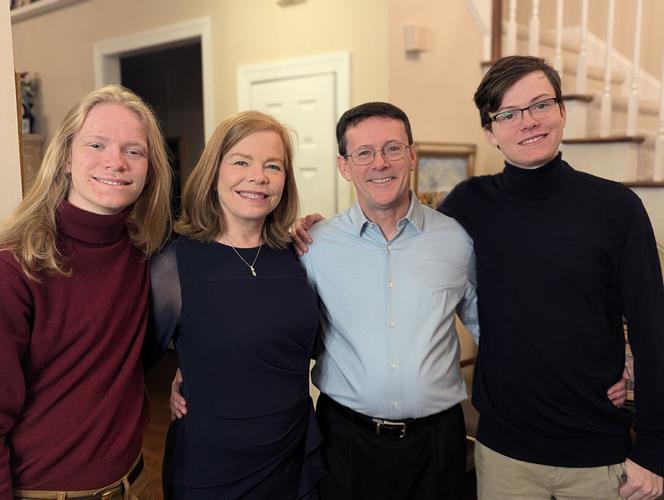
After her sons were diagnosed with retinitis pigmentosa, Martina Manning ’90 turned personal devastation into raising awareness for a possible cure.
In the corner of a quiet exam room, Martina Slaughter Manning ’90 forced herself to stay still. Her son sat in the chair, mid-exam, as the doctor delivered the diagnosis: retinitis pigmentosa (RP), a disease she had never heard of with no cure and one that meant, in the simplest and most devastating terms, that both her children could lose their sight.
“I can remember my son looking over to me to see how I was going to react,” Manning said. “And it was the hardest thing in my life to keep myself from just having a breakdown right there.”
She did not break, but the diagnosis did more than threaten her sons’ vision — it revealed how easily a life-altering disease can exist in plain sight, unnoticed until it is unavoidable.
People are also reading…
A blinding diagnosis
For years, the signs had been there. Manning remembers family trips where her children bumped into walls in dimly lit spaces or struggled to navigate movie theaters, and she had a lingering sense something was not quite right. Yet every time she sought answers, the explanations she received — astigmatism and nothing more — were simple and manageable.
“I just kept thinking, life is good, life is grand,” Manning said. “Even though I thought it was very odd that they couldn’t see.”
Like many families, she had no framework for something more serious. She did not know the medical history of her husband’s family. She did not know what retinitis pigmentosa, often called RP, even was. She had never known anyone who was blind.
It was not until her younger son, then in college, struggled to navigate a darkened aquarium that the concern sharpened into urgency. That moment led to a referral, then another, and eventually to specialists who could finally name what had been hiding in plain sight.
Both of her sons had a genetic condition affecting the retina that slowly erodes eyesight over time. First, night vision, then, potentially, day vision.
The progression is unpredictable, the timeline uncertain, making the unknown all the more terrifying. All Manning could discern at the time was the worst possible outcome, and the months that followed held a kind of quiet grief she carried largely alone.
“When I first found out, it meant my children were going to go blind,” she said. “I cried every day. I walked my neighborhood crying because I didn’t want anybody to see me. I hid in my closet, and I cried.”
For former TV news anchor Gayle Guyardo ’89, Manning’s longtime friend and now a board member of her foundation, that moment was unforgettable.
“She was absolutely devastated,” Guyardo said. “It was one of those moments where you could feel the weight of the news in the room. She was heartbroken, almost hysterical, which is completely understandable for any mother.”
They had met decades earlier as students at Auburn University, forming a friendship that would span nearly 40 years. Guyardo knew Manning well enough to recognize both her pain and what would eventually follow.
“If there is anyone in the world who can take devastating news and turn it into purpose, perseverance, and action, it’s her,” she said.
Manning did not dwell in the grief. She stepped away from her career in Lean Six Sigma consulting, a role she excelled at, and redirected her focus entirely. If there was even the smallest chance to change her sons’ future, she was going to pursue it.
“I wasn’t going to take no for an answer,” she said. “If there was anything that I could do to keep my children from going blind, then I had to do that.”
What she discovered was both encouraging and frustrating. Scientists were working toward treatments. Gene therapy, targeting the root cause of the disease, offered real hope, and some early trials showed promise. But there was a problem.
“They can have all kinds of grand ideas, but getting funding for an idea is impossible,” said Manning.
Without initial funding — what researchers call proof-of-concept support — many of those ideas never move forward. That gap, she realized, was where she could step in.
She founded the RP Gene Research Foundation with a goal that was simple, in theory: to raise money to help fund early-stage research that could lead to a cure. But in practice, it has been anything but simple.
Despite relentless outreach, digital campaigns, a Google Ads grant, media appearances and even a PBS feature, Manning has only raised about $5,000 so far. While a meaningful amount on its own, it is a fraction of what is needed for a single research project — upwards of $1.5 million.
Even when funds are available, institutional barriers can slow progress. Within Duke University, the research institute she works closely with, restrictions have limited how donations can be used without formal grants.
Momentum exists, but it moves slowly. And yet, Manning keeps pushing, not just for funding, but for awareness — something she has come to see as just as critical. Through her website and outreach efforts, Manning has connected with families searching for answers, students inspired to create solutions and individuals navigating the same diagnosis her family faced.
“I don’t want anybody to feel like they’re alone in this,” said Manning.
The end of RP in sight
There are signs that science is catching up, with clinical trials underway and the success of newer treatments. While there are more than 100 genetic variations of RP, making it a complex and moving target, researchers are making progress.
Manning holds onto that progress tightly. When she first heard the word “incurable,” it felt definitive and final. Now, she sees it differently.
“I do think that it is curable,” she said. “It’s just about getting resources for that cure.”
Today, her sons are still navigating the early stages of the disease. Their day vision remains strong. Their night vision presents challenges. The future is uncertain, but not without hope.
Manning continues to build, slowly, persistently, toward something bigger than her own family, asking people to see what she once could not.
In the fight against retinitis pigmentosa, preserving vision is a fraction of the battle. The rest comes from recognizing a disease that often goes unnoticed and understanding that awareness can shape outcomes.
“I want people to be more hopeful than I was — we’re closer to a cure now than we were then,” said Manning. “I’m assured that soon there will be one.”


