


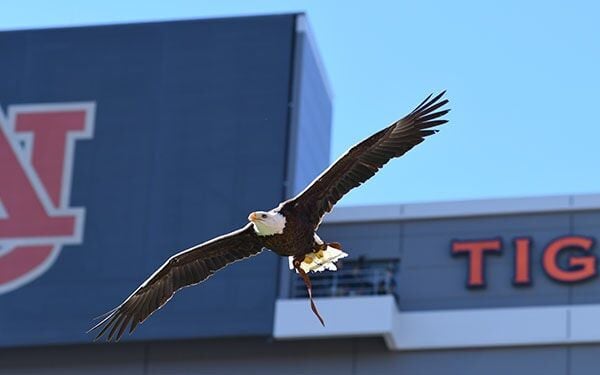
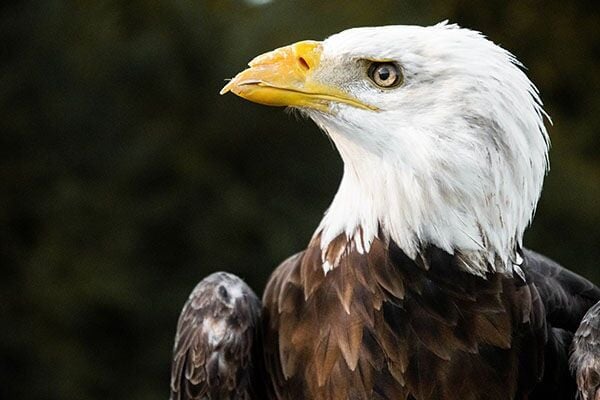
Spirit, a bald eagle ambassador at the Auburn University Raptor Center (AURC), will undergo a surgical procedure to address cataracts in one eye to restore her vision and support her long-term quality of life.
The AURC, a division of Auburn University’s College of Veterinary Medicine, has been monitoring the development of cataracts in Spirit’s eyes. Cataracts cause clouding of the eye’s natural lens, interfering with the passage of light and potentially resulting in progressive vision loss. Her veterinary team has recommended phacoemulsification, commonly known as phaco surgery, to remove the affected lens and improve her visual function.
“Vision is an important part of how raptors experience and navigate their environment. It contributes to their ability to make choices and engage in the behaviors that make their lives enriching,” said Dr. Robyn Miller, director of the AURC. “Our goal is not simply to address a medical condition, but to give Spirit the opportunity to continue experiencing the world as fully and comfortably as possible.”
People are also reading…
Spirit’s veterinary and raptor care teams will provide dedicated care throughout the procedure and recovery, with close attention to her comfort, healing and overall welfare. Her activity and participation in educational programming will be determined by her recovery and individual needs. As part of her training, Spirit is already well-versed in cooperative care behaviors, allowing her to voluntarily participate in receiving eye drops and other treatments. This decreases stress and should allow Spirit to make a soaring recovery.
Dr. Amberly Sokoloff, the Raptor Center’s veterinarian, estimates that Spirit’s recovery will take approximately three to four weeks.
“We have a specially made artificial lens that will be implanted during surgery, which should further improve her vision,” Sokoloff said. “We are very hopeful about her prognosis.”
Spirit also has a cataract in her other eye; however, examinations and diagnostic testing indicate that she has not experienced the same degree of vision loss in that eye. Because cataracts can progress over time, she may eventually need a similar procedure on her other eye.
Although cataracts can develop as part of the aging process, their effects can extend beyond changes in eyesight. For a visually oriented predator like a bald eagle, maintaining functional vision can play an important role in environmental awareness, behavioral engagement and overall well-being. Addressing the condition offers Spirit an opportunity to maintain those important aspects of her daily life.
“Spirit has touched countless lives throughout her years as an ambassador,” said Amanda Sweeney, AURC assistant director of training and education. “Behind her is an exceptional team that is deeply committed to ensuring the best possible outcome for her.”
Spirit celebrated her 30th birthday (or “Birdie 30”) this year. She made her “War Eagle Flight” debut in 2002, becoming the first bald eagle to participate in Auburn’s pre-football game tradition. After 19 years of flights, Spirit retired in 2021 and was named an honorary War Eagle, a distinction typically reserved for golden eagles.
Today, Auburn’s pregame flight tradition continues with Aurea, War Eagle VIII, and Independence, or “Indy,” another bald eagle. Though retired from pregame flights, Spirit still participates in educational outreach and is one of 20 resident ambassador raptors who help connect students and the public with these remarkable birds. The AURC also typically treats as many as 300 injured, ill or orphaned raptors each year, with the goal of returning as many as possible to the wild.


