


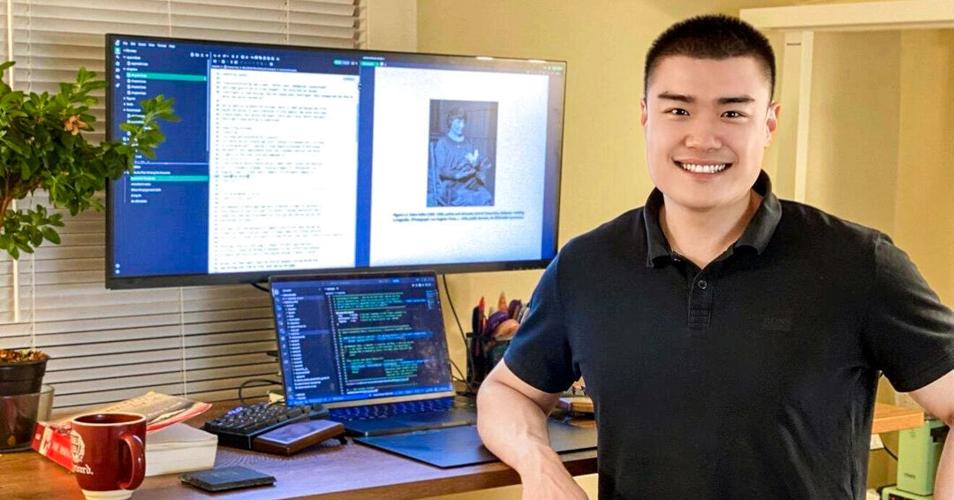
Franklin Wang didn’t think much of the collision at first.
A man riding an electric scooter hit him while he was biking across campus. His bicycle was damaged, but Wang was okay. At least he thought he was.
A week or so later, he started losing vision in one eye.
“I thought I was just tired,” Wang said.
He wasn’t.
Doctors soon discovered his retina was detaching.
What followed was a whirlwind of appointments from Auburn to Montgomery before emergency surgery in Birmingham.
Throughout it all, Wang carried the same orange-and-blue backpack.
At his first appointment, an eye specialist noticed the Auburn logo immediately.
People are also reading…
“War Eagle,” the doctor said before explaining the injury required a retina specialist.
At the next appointment, it happened again.
Another doctor spotted the backpack, smiled and said, “War Eagle.” He referred him to specialists at UAB Hospital, where surgeons were able to save his eyesight.
The recovery wasn’t simple. For nearly a month, Wang had to keep his head in the same position while his eye healed. Reading anything was out of the question.
Instead, the mathematics doctoral student turned to the VoiceOver feature on his iPhone.
That’s when he discovered a problem he’d never noticed.
Whenever the screen reader reached a figure, graph or image, it stopped short.
“Figure 1.8,” it would say. Then… nothing.
“There wasn’t an explanation,” Wang said. “I realized how difficult it is when information isn’t accessible.”
Turning a challenge into change
Growing up, the Beijing native learned about Helen Keller. Her story stayed with him, making it even more meaningful to build accessibility resources in the state where she was born.
This summer, Wang is creating an accessible LaTeX dissertation template that will help graduate students in mathematics, engineering, physics and other technical fields produce dissertations that work seamlessly with screen readers.
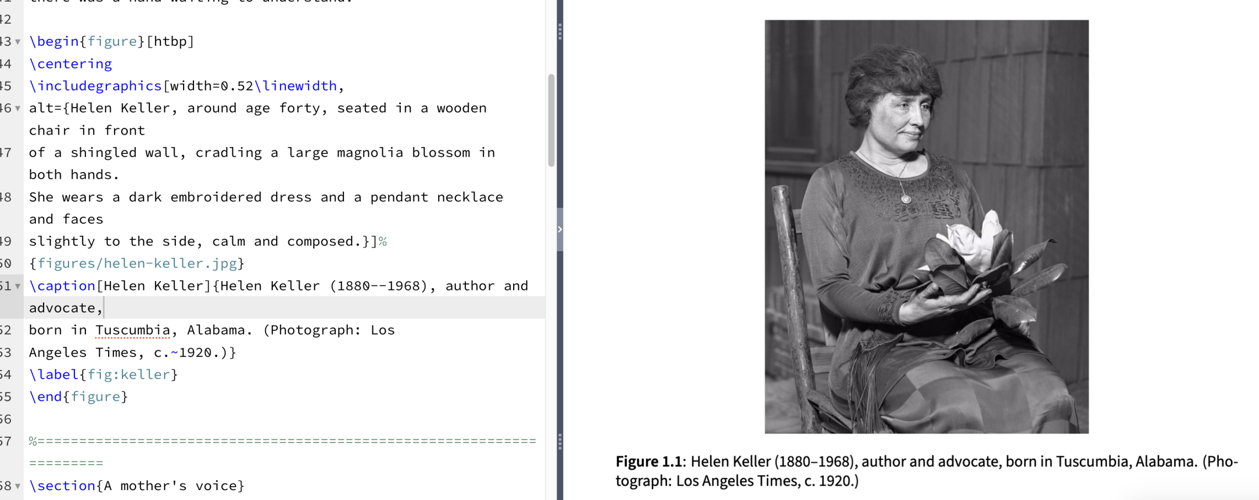
Instead of simply announcing an image or equation, the documents will include alternative text describing what’s actually there. This allows visually impaired readers to fully understand the material.
It’s the kind of improvement many readers may never notice. For someone relying on assistive technology, it changes everything. “If someone spends one extra afternoon making something accessible, it can make it much easier for someone else,” Wang said.
Ash Abebe, interim dean of the Graduate School, said Wang’s work has become an important part of Auburn’s broader effort to improve accessibility for graduate students.
“Franklin has been a real asset to the Graduate School this summer,” Abebe said. “He has brought technical skill, patience and a very practical approach to the work.”
Wang’s background in advanced mathematics gives him a unique understanding of both the power of LaTeX and the challenges that come with making highly technical research digitally accessible to a broader audience.
A screenshot of Franklin Wang's accessible dissertation template shows alternative text describing a photograph of Helen Keller, allowing screen reader users to access the image's content.
Finding purpose through service
Wang came to Auburn from China nearly four years ago after searching for a university known for its strength in algebra.
His previous university didn’t have the faculty specializing in the subject he wanted to study, so he taught himself — until he found Auburn.
These days, Wang spends his time balancing doctoral research with teaching undergraduate algebra and calculus.
His favorite part isn’t proving new mathematical ideas. It’s watching students realize they’re capable of solving problems they once thought were impossible.
“I give them the methods and encouragement,” he said. “Then they grow by themselves.”
Helping students doesn’t stop when Wang leaves the classroom.
As a senator on Auburn’s Graduate Student Council, he works to improve graduate student life across campus. After hearing concerns from fellow graduate students — particularly international students — Wang began advocating for changes that could ease financial burdens on students. His work has included raising concerns about health insurance costs and connecting students with resources like travel funding and childcare assistance.
Abebe is proud of his efforts and passion.
“I have appreciated Franklin’s service through the Graduate Student Council,” Abebe said. “He has been thoughtful and proactive in keeping students informed and bringing their concerns forward.”
Following Wang’s eye surgery, he needed to keep his head at a fixed angle for weeks while his retina healed. Abebe worked with him to delay exams and arranged for a private office where Wang could set up the equipment he needed to continue his coursework during recovery.
That support left a lasting impression. It reinforced something Wang had already begun to learn throughout his time at Auburn.
“If you need help, ask,” Wang said. “People here really do help you.”
Building a legacy of accessibility
Today, Wang hopes other graduate students know they don’t have to navigate challenges alone.
He’s also looking ahead to his next project aimed at helping others: an AI-powered application that can describe images and figures in older PDF textbooks.
But Wang doesn’t see the accessible LaTeX template as the finish line. He hopes it’s just the beginning.
“I want this project to continue after I graduate,” Wang said. “I want future students to improve it and keep building on it.” Abebe has watched Wang bring that same mindset to his research, his leadership and his advocacy for fellow graduate students.
“Franklin is developing not only as a scholar but also as a student leader and advocate,” Abebe said. “He represents the kind of graduate student that makes Auburn better.”
The accident that nearly took Wang’s vision gave him a different way of seeing the world.
Now he’s making sure future students have the tools to help others see it, too.


