


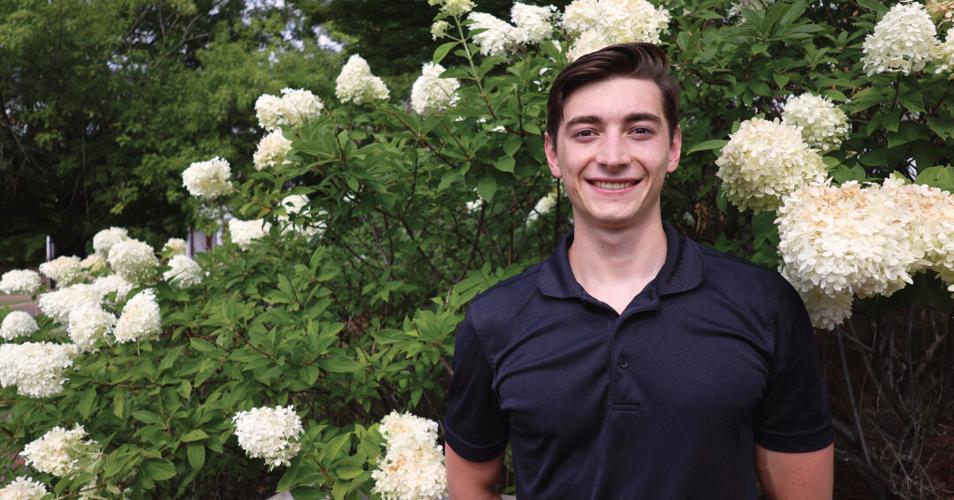
Auburn physics graduate student Cordell Umland has been selected as a National Science Foundation Graduate Research Fellowship (NSF GRFP) recipient for 2026. This prestigious fellowship supports outstanding graduate students in STEM fields and provides three years of financial support, including a $37,000 annual stipend.
Umland is a first-year Ph.D. student in physics whose research focuses on understanding how dust particles become electrically charged in plasma environments, a process that affects environments ranging from semiconductor manufacturing to lunar surfaces. His project, “Quantifying Dust Charge Though Photo-Discharging,” focuses on how dust grains collect charge when exposed to ultraviolet light in a plasma environment. To do this, Umland uses UV light to change the charge on individual dust particles and then tracks how they move inside of plasma. By measuring a particle’s position, velocity and the surrounding plasma condition he can calculate the exact charge each grain carries. Umland’s work will be conducted in Auburn’s Magnetized Plasma Research Laboratory (MPRL).
People are also reading…
“I am incredibly grateful for the support I’ve received throughout my research journey,” said Umland. “Working in the Plasma Research Laboratory has pushed me to think creatively. I especially want to thank Dr. Edward Thomas Jr. and Dr. Saikat Chakraborty Thakur for their mentorship and encouragement. Their guidance has shaped the way I approach research and I’m excited for the opportunities this fellowship will create as I continue exploring the physics of dusty plasma.”
Umland’s research has the potential to influence several critical areas of science and technology. A deeper understanding of dust charging can improve efficiency in semiconductor manufacturing, where even small particles can contaminate microchips and lead to costly production losses. His work also supports advancements in fusion energy, since dust from eroded reactor walls can weaken plasma performance and reduce the fuel available for sustained reactions.
“Cordell’s selection for the NSF Graduate Research Fellowship is wonderful news, and we are incredibly proud of him,” said Edward Thomas, Jr., dean for the College of Sciences and Mathematics. “This fellowship recognizes not only his talent and hard work, but also the promise of the research he is doing here at Auburn. Cordell’s work is addressing a very fundamental question in plasma physics. This will be a challenging, yet impactful project and I’m excited to see where his curiosity and dedication take him.”
“Congratulations to Cordell on this outstanding national recognition,” said Ash Abebe, interim dean of the Graduate School. “An NSF Graduate Research Fellowship is a significant accomplishment, and we are pleased to see an Auburn graduate student recognized at this level. His success also reflects the strong research environment and mentorship in our physics program. We look forward to seeing where his talent and hard work take him."
The National Science Foundation Graduate Research Fellowship Program plays a central role in supporting students like Umland as they pursue high-impact scientific work. Established in 1952, the NSF GRFP is the oldest graduate fellowship of its kind and is designed to strengthen the nation’s leadership in science, technology, engineering and mathematics. The fellowship provides three years of financial support, including a $37,000 annual stipend and additional funding for tuition and research expenses. Beyond financial assistance, the program offers professional development opportunities and access to a national network of researchers, innovators and mentors. By investing in early-career scientists, the NSF GRFP aims to advance groundbreaking research, expand the STEM workforce and support discoveries that benefit the state, the nation and the world.


