



There’s moving artwork. And then there’s moving artwork.
In the College of Human Sciences’ Phygital Design Lab, students are using artificial intelligence, 3D printing, digital modeling and augmented reality to turn art history into something people can touch, explore and even walk through. Wall paintings come to life. Cross-stitched birds take flight. A carriage that survives only as a tiny detail in a centuries-old painting is reconstructed in three dimensions — all through your phone screen.
“We don’t have to separate something called digital and something called physical anymore,” said Georges Fares, assistant professor of interior design. “You can have both.”
Old art, new technology
Fares and Anna Ruth Gatlin, associate professor of interior design, founded Phygital after discovering a shared love of hands-on research and a willingness to ask one question again and again: What if?
People are also reading…
“Part of what Phygital Design Lab does is try to change people’s perspectives about what they are engaging with,” Gatlin said. “A 2D piece of Baroque art is not boring. It can be animated; it can be 3D printed. You can watch it on your phone with music.”
Baroque art, known for its elaborate details and sense of drama, became popular across Europe in the 1600s and early 1700s. For someone unfamiliar with the period, however, its paintings, patterns and even furniture can feel distant.
Phygital is finding ways to close that gap.
The pair received funding through an internal Auburn research grant and traveled to Italy in December 2024 to document the Palazzo Chigi, a centuries-old palace in Ariccia designed by famed Italian artists Gian Lorenzo Bernini and Carlo Fontana.
The palace now serves as a museum and cultural center and, since 2009, has provided a unique learning environment for students in the College of Human Sciences’ international study program, the Joseph S. Bruno Auburn Abroad in Italy Program. Students live in the palace for a semester, learn from Italian experts, travel throughout Italy and earn an international minor.
Fares and Gatlin arrived with cameras, phones and a plan to photograph and scan pieces of the palace, then reinterpret them back at Auburn. Then they stepped inside.
“We realized that we hadn’t thought big enough,” Gatlin said. “We could honestly spend our whole lives at the Chigi Palace studying it.”
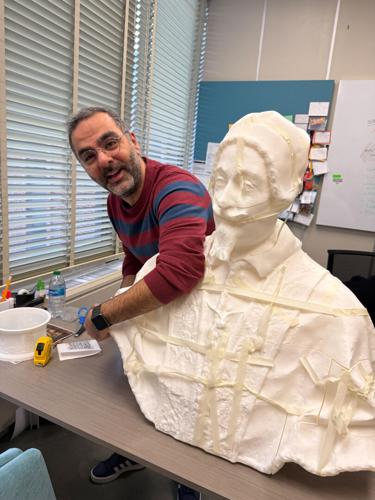
Palace officials opened rooms, cabinets and collections typically unavailable to visitors. Director Francesco Petrucci gave the team access to spaces most visitors never see, giving the Auburn team compelling material for projects ranging from recreating frescoes and royal birds to 3D printing a replica of a marble bust of Pope Alexander VII.
“When we went to the palace, we were looking at this place going, ‘We can do way more than this. Are you kidding me?’” Fares said. “What we’ve done so far is just a warmup.”
Return of the carriage
Few projects capture that ambition better than the lost carriage.
The Carriage of the Acorns was built for Cardinal Flavio Chigi, a powerful church leader and member of the Chigi family, which owned the palace from 1661 to 1988. It was adorned with gold ornamentation, cherubs, ribbons and carved screaming-head finials.
Over time, most of the carriage disintegrated.
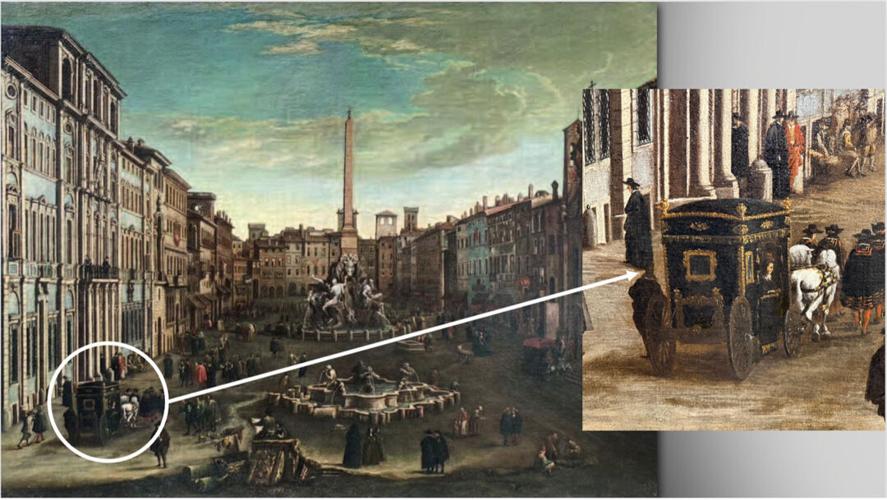
Only a few pieces survived: the screaming-head finials, adornments that once sat above the windows and one window frame that was later repurposed. One tiny image of the original carriage also survives, tucked inside a much larger painting.
Petrucci asked the team if they could digitally bring it back to life.
Auburn interior design student and undergraduate research fellow Sarah Hill used those clues to digitally reconstruct the entire carriage. The team used augmented reality to place that full-size digital model outside the Palazzo Chigi, where the original may have stood centuries ago.
“That was my favorite project because I completely 3D-modeled everything myself,” Hill said. “The impact is so much bigger than the little piece that I did. Seeing how it has translated to other areas and how other people appreciate it has been really fulfilling.”
The model was later displayed in Haley Center, where visitors could look through their phones and virtually walk around — and even through — a carriage that no longer exists.
“I see my work all the time, so I’m just like, ‘Yeah, OK. Time for the next project,’” Hill said. “Then you see someone seeing it for the first time and you’re like, ‘Wait, this is really cool. And I did that.’”
Don’t just look, touch
The lab is also changing who gets to experience art and how.
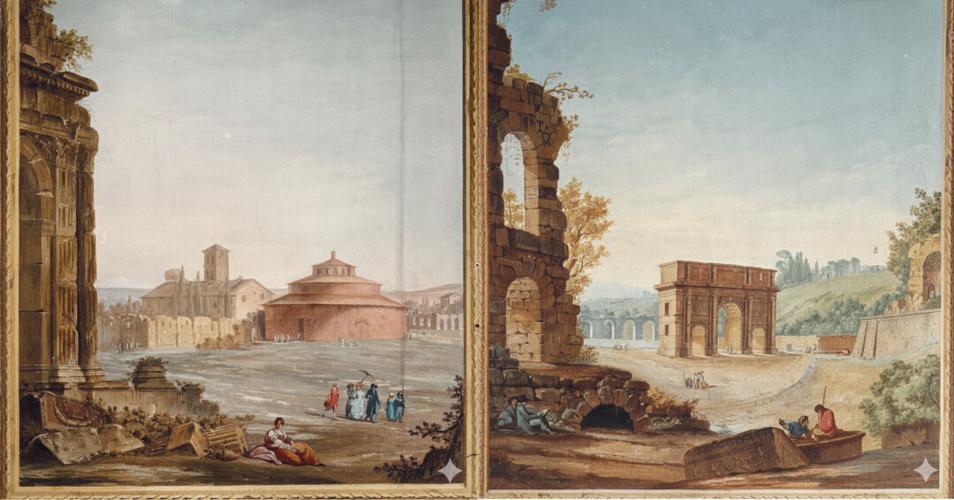
Using AI-assisted modeling and 3D printing, researchers are working to turn the palace’s 2D frescoes into 3D objects people can touch.
Instead of only hearing someone describe a painting, people who are blind or have low vision can feel the curve of a hill, the placement of a building or the people gathered in the scene.
“Typically, they tell you not to grab or touch,” Fares said. “We’re telling people, ‘No. You learn more by touching, and you remember it more.’”
The team also used AI to animate five of the frescoes. Viewers can hover their phones over the image and watch still figures and landscapes come to life.
For Hill, the result looked like something from “Harry Potter.”
The technology isn’t meant to replace the original artwork. It gives viewers another way to understand its story, scale and smallest details — no art history degree required.
“Even when I look at a fresco, I don’t necessarily comprehend the scale or fully understand what is happening unless I intentionally stand there and study it,” Gatlin said. “By creating different ways of interpreting frescoes, you very quickly begin to understand what is happening in that space.”
The lab applies that same approach to nearly everything inside the Palazzo Chigi.
Gatlin has cross-stitched palace-inspired patterns onto 3D-printed panels, combining traditional handwork with modern technology.
Former undergraduate researcher Darby Huber even turned the palace’s floors, walls, symbols and decorations into five sets of handcrafted acrylic nails.
“You almost overlook the flooring because there is so much happening in the palace,” Gatlin said. “When we show you these fingernails, you start to hyperfocus on things you overlooked before.”
Nothing is too old to become new again. Nothing is too grand to be made miniature. And no idea is dismissed simply because it sounds impossible.
“A lot of crazy ideas, some that seem unattainable, will always be heard,” said undergraduate research fellow Sarah Joy Ficks. “It’s opened my eyes to the boundaries of design.”
“What else can I do?”
For the students, the lab offers something a traditional assignment cannot: the freedom to experiment, fail, start over and create work that leaves the classroom.
There are no test tubes or lab coats. Instead, students gather around a whiteboard filled with ideas, share their latest designs and learn unfamiliar technology as they go.
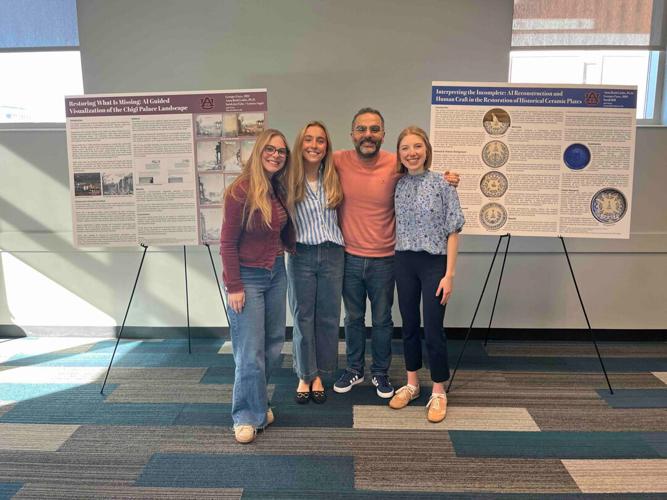
Ficks, alongside undergraduate researcher Lauren Augér-Dunn, used AI to digitally reconstruct parts of damaged wall paintings. The project began with one conversation over coffee and grew into research presented internationally.
“That one little afternoon built everything for me,” she said. “Inherently, art is never machine operated. You have to have some human connection with it.”
The students’ names and faces appear alongside their faculty mentors in presentations because, Gatlin and Fares said, the work would not exist without them.
“They come into our lab thinking they don’t know what to do,” Fares said. “Then they finish something and say, ‘I cannot believe I did this.’ It allows them to then ask, ‘What else can I do?’”
That question continues to push the lab forward.
The team hopes to return to Italy with better equipment, document more of the palace and create a digital collection capable of preserving — and sharing — its artwork, furnishings and stories.
“There’s so much in that palace that no one knows about and that only exists in there,” Fares said. “Imagine if we, as a university, were the ones who documented and preserved it in this way. How amazing is that?”


