


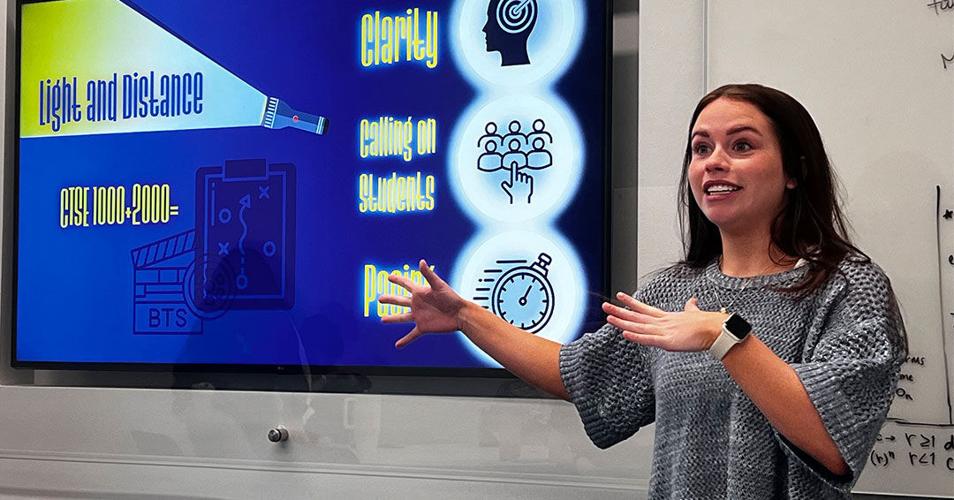
An AUTeach student is pictured sharing a presentation with classmates, reflecting on her experiences visiting elementary and middle school classrooms this spring.
As the demand for science, technology, engineering and mathematics (STEM) talent continues to grow across Alabama and the nation, Auburn University is leading the charge to strengthen science education through innovative programs designed to prepare the next generation of teachers. At the center of this effort is AUTeach, a dynamic, cross-college initiative equipping students with the knowledge, experience and passion to transform science classrooms across the state.
Housed in both the College of Education and the College of Sciences and Mathematics, AUTeach offers a forward-thinking solution to Alabama’s pressing science teacher shortage — recruiting undergraduate science majors and guiding them toward certification through a streamlined, hands-on approach.
People are also reading…
“AUTeach’s goal is to recruit, prepare and support science majors at Auburn to become fully certified science teachers through hands-on teaching experiences and a streamlined double-major pathway,” said Matthew McVay, co-director of AUTeach and clinical lecturer in the College of Education’s Department of Curriculum and Teaching. “In turn, this will also support state initiatives to grow the STEM workforce around the state for STEM industries that are continuously growing.”
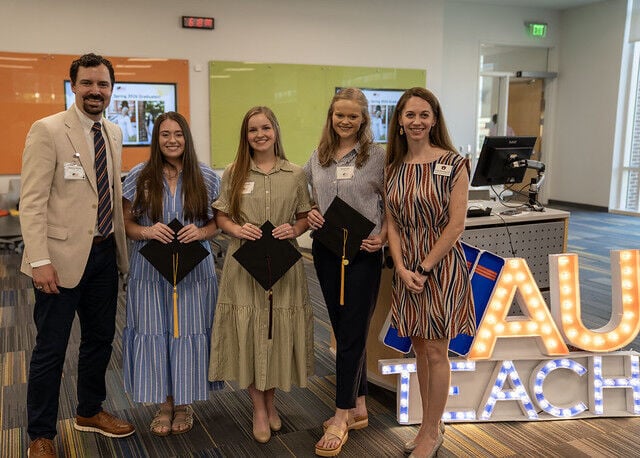
Spring 2026 AUTeach graduates are pictured at their end-of-the-year celebration. Pictured are, left to right, Matt McVay, AUTeach co-director for the College of Education; Acacia Sweatmon; Blaire Lyles; Morgan Still; and Brittany McCullough, AUTeach co-director for the College of Sciences and Mathematics.
A measurable difference
AUTeach is already making a measurable difference. The program has graduated six students to date — three in spring 2025 and three in spring 2026 — with projections of as many as 12 graduates in the next academic year.
Among the most recent graduates are Morgan Still and Blaire Lyles. Still and Lyles have already secured positions as science teachers — an outcome that underscores both the quality of the AUTeach program and the urgent need for qualified science educators across Alabama.
Lyles, who will begin her career as a science teacher at Auburn Junior High School this August, reflected on the impact of the program:
“AUTeach was truly the best part of my Auburn experience,” Lyles said. “It gave me friends, family, a purpose and a career. When I started the program, I had no idea that it would uncover a true love for teaching and educating that had always been hidden somewhere within me. The AUTeach professors have a way of pulling out and molding the ‘teacher qualities’ that a person possesses. I am forever indebted to this program, as it has shaped my future in ways that would not be possible without AUTeach. The most special thing about AUTeach is that it takes ordinary science majors and empowers them not only to do science themselves but to teach science to others. If you go through the AUTeach program, whether you end up teaching in a classroom or not, you will earn a skillset that will impact the rest of your professional career. AUTeach truly made me feel like a part of what we call the Auburn Family.”
Interest in AUTeach has surged alongside its success, with the program growing from just 16 students in its inaugural semester in fall 2023 to 75 students as of spring 2026. An additional 25 to 30 students are expected to enroll in introductory courses this fall.
“We have seen several students take our introductory courses because of the positive reviews they have heard from fellow COSAM students,” said Nathan Tubbs, a faculty member for AUTeach. “In fact, we have had several roommates, friends and even siblings enroll in our courses based on the positive experiences our students have had.”
Brittany McCullough, who is in her first year as a co-director of AUTeach in the College of Sciences and Mathematics, said she’s been very impressed by the passion of the faculty and staff involved and the dedication of the students.
"We are so grateful that our students in COSAM have the opportunity to participate in a program that provides them with such valuable hands-on experiences early in their academic careers,” she said. "In addition to the AUTeach courses, the K-12 classroom experiences and internship opportunities through organizations such as COSAM Outreach are truly enriching their undergraduate experience."
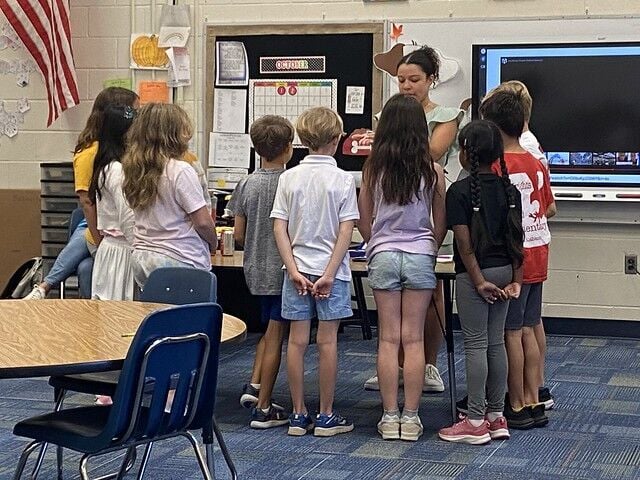
AUTeach student Taylor Rakestraw teaches a science lesson to elementary students in Auburn City Schools.
A hands-on pathway to teaching
AUTeach sets itself apart through early, immersive teaching experiences that begin in a student’s first semester. Through exploratory courses and continued field-based engagement, students gain firsthand experience delivering science lessons while developing critical professional skills.
Students begin with a one-credit exploratory course that introduces the fundamentals of science teaching and classroom management. From there, those who choose to continue enter a structured series of coursework and field experiences that culminate in a teaching internship under the guidance of a mentor educator.
This approach ensures that students graduate in four years with both an education major and a science major, along with certification to teach grades 6–12 science in Alabama public schools.
“AUTeach provides early, hands-on teaching experiences,” McVay said. “We facilitate authentic, field-based teaching experiences throughout the AUTeach program, starting the very first semester. This helps prospective double-majors decide whether science teaching is for them.”
A central aim of AUTeach is to reshape how science majors view teaching — not just as a viable career path, but as a meaningful and impactful vocation.
“Passion is an important element of teaching,” Tubbs said. “By recruiting COSAM students who are excited about science and giving them a chance to explore teaching, we have the great opportunity to equip science teachers who are not only knowledgeable, but also passionate about their content. A passionate science teacher is infectious and passes that passion along to their students, creating people who are excited about science and science careers.”
The program also addresses misconceptions about the teaching profession. Through initiatives like the Alabama TEAMS Act of 2021, science teachers in the state now earn higher salaries than many students realize, while also benefiting from strong job demand and meaningful community impact.
“I am a COSAM graduate and had no plan to enter the classroom,” Tubbs said. “However, when an opportunity to teach was presented to me, I quickly learned that I enjoyed teaching and that teaching was a great career in terms of salary, benefits and work-life balance. I want to do my best to relay this to students in order to not only change their perceptions but also recruit new teachers.”
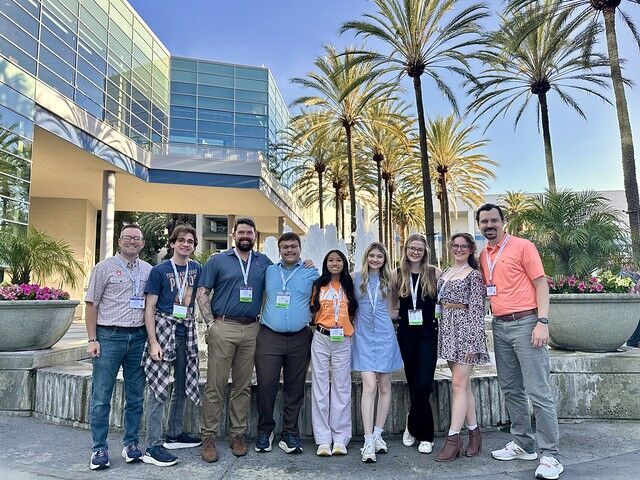
AUTeach students attend the National Science Teachers Association (NSTA) conference in Anaheim, California in April 2026.
Strengthening Alabama’s future workforce
At its core, AUTeach is about more than teacher preparation — it is about strengthening Alabama’s entire STEM ecosystem. By increasing access to high-quality science education in middle and high schools, the program is helping ensure students are better prepared to pursue STEM careers that drive economic growth across the state.
“AUTeach exists to meet a need that affects families throughout our state,” McVay said. “Many school districts in Alabama don’t have enough science teachers, necessitating some high schools to drop higher-level science courses and even have science courses be taught by teachers not trained in science. We want to do our part to ensure that every student in Alabama has access to amazing science teachers in middle school and high school that will bolster their students’ science literacy, motivate them to think more deeply about the natural world around them and inspire them to consider — and prepare them for — a career in STEM.”
In AUTeach’s first three years, students in the program have already engaged with more than 4,700 K–12 students across seven local school districts, delivering hands-on lessons that emphasize inquiry-based learning and real-world scientific exploration.
AUTeach students also extend their learning beyond the classroom through professional conference opportunities. AUTeach students have attended the National Science Teachers Association conference in Anaheim, California, and the Alabama Science Teachers Association conference. In July, AUTeach students will also have the opportunity to attend the Knowles Teacher Initiative’s annual meeting at the Georgia Tech Hotel and Conference Center in Atlanta. The Knowles Teacher Initiative supports a national network of math and science teachers who are collaborative, innovative leaders improving education for all students in the United States — an effort that Auburn’s College of Education is fully committed to as it explores ways to expand STEM efforts and increase the college’s impact in that area.
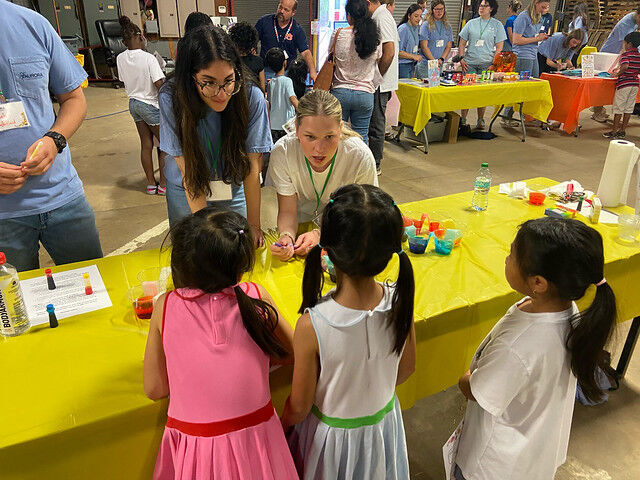
AUTeach students are pictured volunteering at the Spring Into Science event, an AU STEM outreach event designed for K-8 students in the Auburn/Opelika area.
A collaborative, supported experience
AUTeach is designed to support students at every stage of their journey. From scholarships and tuition reimbursements to dedicated advising and mentorship, the program removes barriers and fosters a sense of community among participants.
“AUTeach faculty and staff provide a personal level of support for students from start to finish,” McVay said. “AUTeach students often express that they have valued the community they have found within the AUTeach program.”
Students also benefit from professional skill development in communication and leadership — preparing them for success not only in the classroom, but in a wide range of STEM-related careers.
AUTeach directly aligns with Auburn University’s commitment to innovation, excellence and community impact. Supported through funding from the Alabama Legislature via the Alabama Commission on Higher Education, and with oversight from the Alabama STEM Council, the program is part of a broader statewide and national network dedicated to strengthening science education.
“Our state needs more science teachers. This is a pressing need in many areas of the state,” McVay said. “AUTeach is seeking to address this need, and we are already seeing graduates go out and make a difference in their communities.”


